The Role of MLS Listings Explained for Home Sellers

The Multiple Listing Service (MLS) is a centralized, real-time database that licensed real estate agents use to share, market, and manage property listings. Understanding the role of MLS listing explained correctly is the difference between a home that sells fast and one that sits. The MLS is not a single national website. It is a network of more than 800 regional databases, each maintained by local Realtor associations under strict accuracy rules. Every serious seller needs to understand how this system works before signing a listing agreement.
How MLS listings work: process and key components for sellers
The MLS listing process starts the moment a licensed broker submits your property to their regional database. You cannot list directly on the MLS as a homeowner. A licensed agent or broker must do it on your behalf.
Here is how the process works from start to finish:
- Broker submission. Your agent enters your property details into the MLS system. This includes square footage, bedroom and bathroom count, lot size, legal description, tax ID, and school district.
- Photos and media upload. High-quality photos, virtual tours, and floor plans are attached to the listing record. Poor photos hurt click-through rates immediately.
- Private remarks added. Your agent fills in the private remarks field, which is visible only to other licensed agents. This section holds lockbox codes, showing instructions, pet warnings, and seller preferences.
- Listing goes live. The listing becomes active in the MLS and is immediately visible to every buyer agent in your region.
- Syndication to public portals. MLS listings syndicate within 24–48 hours to consumer sites like Zillow and Realtor.com, expanding your reach to self-directed buyers.
Pro Tip: Ask your agent to double-check every data field before the listing goes live. A single error in square footage or bedroom count can filter your home out of buyer searches entirely.
The private remarks section deserves special attention. It is the operational backbone of your showing process. Agents use it to coordinate access, communicate seller preferences, and flag any conditions that affect showings. Public portals never display this information.

What benefits do MLS listings provide to sellers?
MLS listings give your home the widest possible professional exposure. 92% of buyer agents rely on the MLS as their primary source for new listings. That single statistic tells you where serious buyers are found.
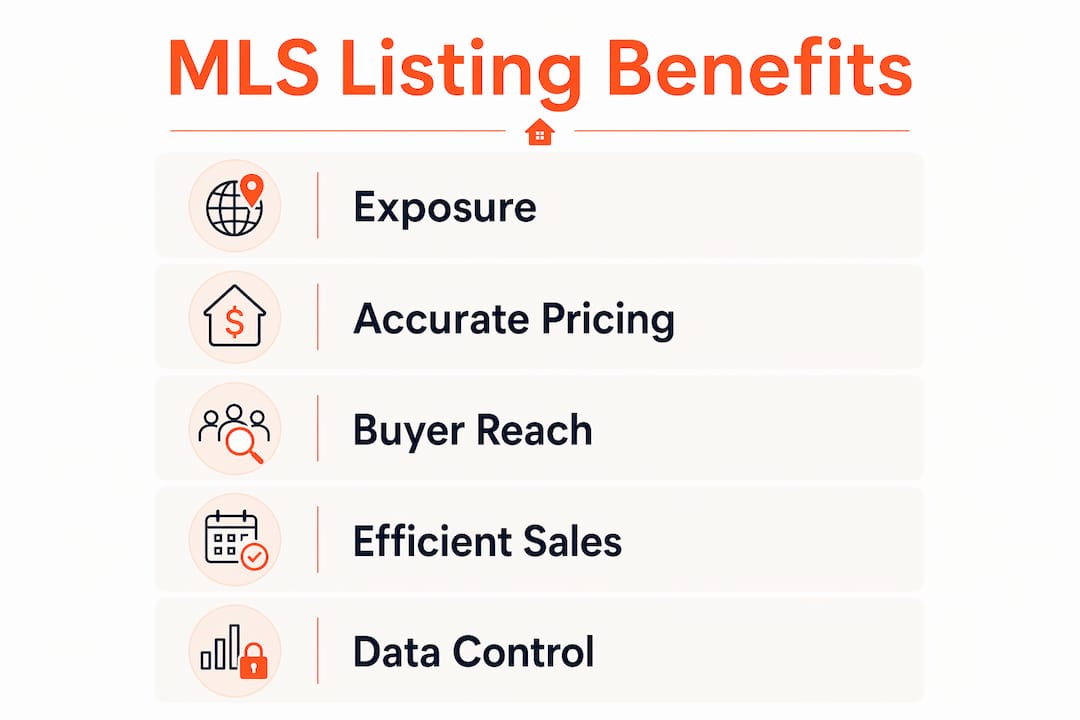
The MLS listing benefits for sellers include:
- Maximum agent reach. Your listing is visible to every licensed buyer agent in your region the moment it goes live.
- Real-time accuracy. The MLS updates instantly when price changes, status changes, or new photos are added. Consumer portals carry 24–48 hour data delays and gaps that can mislead buyers.
- Access to comparable sales data. Agents use MLS sold records to price your home correctly and justify your asking price to buyers.
- Qualified buyer traffic. Buyers working with agents are typically pre-approved and serious. MLS exposure connects you directly to that pool.
- Faster offers. Homes listed on the MLS reach more agents faster, which compresses the time between listing and first offer.
The accuracy advantage is significant. Consumer portals like Zillow pull data from the MLS but display it with a lag. A price reduction you make on monday may not appear on Zillow until wednesday. Agents working directly in the MLS see the change immediately. That speed matters when buyers are comparing multiple properties in real time.
Common misconceptions about MLS listings sellers should know
The biggest misconception sellers hold is that Zillow or Realtor.com is the primary listing source. Those platforms are downstream. The MLS is the original, authoritative record. Public portals are secondary with data delays and gaps that the MLS does not have.
Several other nuances catch sellers off guard:
- Data accuracy is marketing. Incomplete or incorrect MLS data causes listings to be filtered out by buyer search tools, regardless of how good the property actually is. Wrong square footage, missing amenities, or a wrong property type can make your home invisible.
- Buyer-agent compensation changed in 2024. The NAR settlement that took effect in 2024 prohibits buyer-agent compensation disclosure in MLS fields. Sellers must now negotiate buyer-agent compensation separately, outside the MLS. This adds a step to the offer process that many sellers do not expect.
- The private remarks section is not optional. Skipping or rushing this field creates confusion for showing agents and can reduce the number of scheduled tours.
- MLS access requires a licensed professional. You cannot self-list on the MLS. Even flat-fee MLS services require a licensed broker to submit the listing on your behalf.
Pro Tip: Before your listing goes live, ask your agent to run a test search using the filters a typical buyer would use. Confirm your home appears in the results. This takes five minutes and catches data errors before they cost you showings.
The post-2024 compensation change is the most significant structural shift in MLS practice in decades. Sellers who understand it can negotiate buyer-agent fees clearly and avoid surprises at closing.
Full-service agent vs. flat-fee MLS: which option fits your sale?
Sellers have two main paths to get on the MLS. The right choice depends on your time, experience, and comfort with paperwork.
| Factor | Full-service agent | Flat-fee MLS listing |
|---|---|---|
| MLS access | Included in commission | Paid upfront, typically $300–$500 |
| Commission cost | Typically 2.5–3% listing side | Listing side fee only |
| Showing coordination | Agent handles all scheduling | Seller manages directly |
| Negotiation support | Full agent representation | Seller negotiates independently |
| Paperwork and contracts | Agent prepares and reviews | Seller responsible |
| Time commitment | Low for seller | 10–15 hours per week for showings and admin |
| Error risk | Low, agent checks data | Higher without professional review |
Flat-fee MLS listings save money on the listing commission but shift the entire administrative burden to you. Sellers who choose this path often underestimate how much time showings, follow-up calls, and contract review actually require. A full-service agent handles all of that in exchange for their commission. The right choice depends on whether your time is worth more than the commission savings.
For sellers who want to compare agents before committing, Realtorfinder’s seller resources let you receive competing proposals from licensed agents so you can evaluate commission rates and marketing plans side by side.
How MLS data drives home pricing and appraisals
The MLS is the primary historical sales database that agents and appraisers use to price homes. Agents and appraisers rely on MLS sold data to build comparative market analyses (CMAs) and formal appraisals.
| MLS data type | How it is used in pricing |
|---|---|
| Closed sales (comps) | Establishes fair market value range |
| Days on market | Signals pricing accuracy and demand |
| Price reduction history | Reveals overpricing patterns |
| Expired listings | Shows price points the market rejected |
A CMA built from MLS sold data is the most reliable pricing tool available to sellers. Automated valuation models like Zillow’s Zestimate use public records and delayed portal data. They are less accurate than a CMA built directly from MLS closed sales. When your agent recommends a list price, the MLS comps are the evidence behind that number. Sellers who push back on pricing without reviewing those comps often overprice and sit on the market longer than necessary.
Key Takeaways
The MLS is the authoritative, real-time database that connects your listing to buyer agents, drives accurate pricing, and determines how quickly qualified offers arrive.
| Point | Details |
|---|---|
| MLS is the primary source | 92% of buyer agents use MLS as their main tool for finding listings. |
| Accuracy equals visibility | Incorrect or incomplete MLS data filters your home out of buyer searches. |
| Public portals are secondary | Zillow and Realtor.com carry 24–48 hour delays; the MLS updates in real time. |
| Compensation rules changed | Post-2024 NAR rules require buyer-agent fees to be negotiated outside MLS fields. |
| Flat-fee MLS has real costs | Sellers managing their own MLS listing commit 10–15 hours per week to admin and showings. |
What sellers get wrong about MLS listings
Most sellers I talk to think the MLS is just a feed that powers Zillow. That misunderstanding costs them. The MLS is the source. Zillow is a copy of a copy, delayed by a day or two and missing the private logistics data that agents actually use to schedule showings.
The sellers who get the most out of their MLS listing treat data accuracy like a marketing decision, not an administrative checkbox. Every field in that listing is a filter that buyers use. If your home has a finished basement and it is not checked, you are invisible to every buyer searching for that feature. I have seen well-priced homes sit for weeks because the property type was entered incorrectly.
The post-2024 NAR compensation change also trips up sellers who are not prepared. Buyer-agent fees are now a negotiation point separate from the MLS. Sellers who understand this going in can use it as leverage. Sellers who learn about it at the offer table feel blindsided. Reading agent reviews before you choose a listing agent is one of the best ways to find someone who will handle these details correctly from day one.
The sellers who do best are the ones who choose their agent based on data, not convenience. Compare marketing plans, check track records, and ask specifically how the agent handles MLS data entry and showing coordination. Those details determine your outcome more than the list price does.
— Joe
Realtorfinder makes finding the right listing agent straightforward
Choosing the right agent for your MLS listing does not have to be a guessing game. Realtorfinder lets you list your home once and receive competitive proposals from multiple licensed agents, each showing their commission rate, marketing plan, and track record.

You compare agents side by side and choose based on merit. No cold calls, no pressure, and no upfront costs. Sellers using Realtorfinder frequently see commission rates well below the standard 6%, because agents compete for your business. If you are ready to get your home on the MLS with the right professional behind it, find a qualified agent on Realtorfinder today. You can also explore local market data by city to understand what MLS activity looks like in your specific area before you list.
FAQ
What does MLS stand for in real estate?
MLS stands for Multiple Listing Service. It is a regional database maintained by licensed real estate professionals that allows agents to share and market property listings cooperatively.
Can a homeowner list directly on the MLS?
No. Only licensed brokers can submit listings to the MLS. Homeowners who want MLS access without a full-service agent must use a flat-fee MLS service, which still requires a licensed broker to enter the listing.
How is the MLS different from Zillow or Realtor.com?
The MLS is the original, authoritative source. Zillow and Realtor.com pull data from the MLS but display it with a 24–48 hour delay and do not show private agent remarks or real-time status changes.
How did the 2024 NAR settlement change MLS listings?
The NAR settlement prohibits buyer-agent compensation from being disclosed in MLS fields. Sellers must now negotiate buyer-agent fees separately, outside the MLS listing itself.
Does MLS data affect my home’s appraised value?
Yes. Appraisers use MLS closed sales data to establish fair market value. A CMA built from MLS comps is more accurate than automated tools like Zillow’s Zestimate, which rely on delayed public records.
Recommended
Ready to sell smarter?
List your home free and let licensed realtors compete for your listing.
List Your Home Free