Real Estate Agent Branding Guide for 2026

Real estate agent branding is the process of building a clear, memorable personal identity that attracts the right clients and drives consistent business growth. Agents with cohesive branding strategies see up to 23% revenue growth and 80% greater brand recognition compared to those without one. That is not a small edge in a market where buyers and sellers Google your name before they ever call you. This guide walks you through every step of building a personal brand that works: from niche definition and visual identity to professional photography, website strategy, and long-term brand portability.
What is a real estate agent branding guide?
A real estate agent branding guide is a structured framework for defining who you serve, what makes you different, and how you communicate that across every channel. The industry term for this practice is personal branding, and it covers everything from your logo and color palette to your tone of voice and online reviews. Most agents skip the strategy and jump straight to the visuals. That is the single most common and costly mistake in real estate marketing.
How to identify your niche and value proposition
Your brand starts with a decision: who do you serve, and why should they choose you? Agents who try to appeal to everyone fail. Hyper-specificity builds immediate trust and relevance.
Follow these four steps to define your niche and craft a brand statement:
- List your strongest skills and past transactions. Do you close luxury condos, help first-time buyers, or specialize in military relocations? Your track record points directly to your niche.
- Analyze your local market for gaps. If no agent in your area focuses on probate sales or downsizer properties, that gap is your opportunity.
- Define your ideal client in one sentence. “I help growing families find their first home in suburban Denver” is specific enough to build a brand around.
- Write a concise value proposition. Combine your niche, your market, and your differentiator into one or two sentences. This becomes the foundation of every marketing message you send.
Pro Tip: Test your brand statement on five people outside real estate. If they cannot repeat it back to you in their own words, simplify it.
Agents focusing on hyper-specific niches such as military relocation or probate sales consistently outperform generalists. Specificity is not limiting. It is clarifying.
How to build a consistent visual and verbal identity
Strategy comes before visuals. Defining your niche and messaging first means every design decision has a purpose. Skipping this step produces generic assets that look professional but say nothing.

Color palette and logo
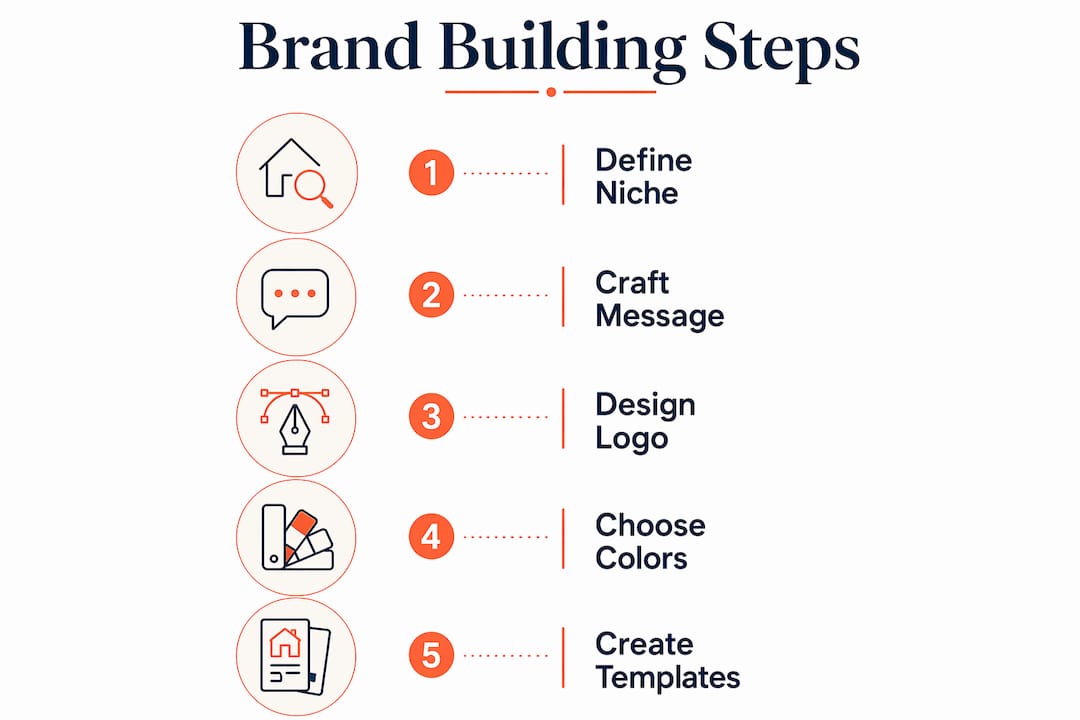
Consistent color usage increases brand recognition by 80%. Limit yourself to one primary color and one accent color. More than two creates visual noise and weakens recall.
Your logo needs to work in multiple contexts:
- Yard signs: Text should be limited to six words for maximum visibility at 30 feet.
- Social media profiles: The logo must be legible at small sizes, such as a 40x40 pixel avatar.
- Print materials: Business cards, flyers, and mailers require a high-resolution version.
- Email signatures: A simplified or icon-only version often works best here.
Logo design variants for both high-resolution digital formats and low-resolution or distant contexts are not optional. They are a practical requirement.
Pro Tip: Design your logo in black and white first. If it does not work without color, the structure is too weak.
Typography and tone of voice
Pick two fonts: one for headlines and one for body text. Use them everywhere. Your tone of voice should match your niche. A luxury agent sounds polished and confident. A first-time buyer specialist sounds warm and reassuring. Neither is wrong. Inconsistency is.
| Brand Element | What to standardize | Why it matters |
|---|---|---|
| Color palette | One primary, one accent | Drives 80% better recognition |
| Logo | Multiple size variants | Works across all media |
| Typography | Two fonts maximum | Maintains visual clarity |
| Tone of voice | Matches niche and client | Builds trust and connection |
| Templates | Social, email, print | Saves time and keeps consistency |
Create templates for your most-used marketing materials: listing announcements, social posts, and email newsletters. Canva and Adobe Express both offer real estate templates you can customize to your brand.
How do professional assets amplify your brand?
High-quality professional assets are the difference between a brand that looks credible and one that gets ignored.
Professional photography
Agents using professional photography earn up to twice the commission compared to those using amateur photos. That return on investment makes photography the highest-impact branding asset you can buy. This applies to your headshot and your listing photos equally. A polished headshot on your website and social profiles signals that you take your work seriously.
Your website as a brand hub
Your website is the one place online that you fully control. Every other platform can change its algorithm or disappear. A strong agent website includes:
- A clear value proposition on the homepage above the fold
- IDX integration so visitors can search listings without leaving your site
- Mobile responsiveness, since most searches happen on phones
- A lead capture form tied to a CRM such as Follow Up Boss or HubSpot
- A testimonials page with real client reviews
Pro Tip: Add a short video introduction on your homepage. Visitors who watch a video stay on the page longer and are more likely to contact you.
Social media strategy
Consistency beats volume on social media. Posting three times a week with on-brand content outperforms posting daily with random content. Focus on content types that align with your niche: neighborhood guides for local specialists, financing tips for first-time buyer agents, and market data for luxury clients. Agent reviews and testimonials are among the most trusted content you can share.
| Asset | Minimum standard | Impact on brand |
|---|---|---|
| Headshot | Professional photographer | Sets first impression |
| Website | Mobile-optimized, IDX-enabled | Central brand hub |
| Social profiles | Consistent handle and bio | Reinforces recognition |
| Testimonials | 10+ verified reviews | Builds client trust |
How to maintain brand coherence across every touchpoint
Branding is a coordination problem, not just a creative one. Every touchpoint, from yard signs to email signatures, must reinforce the same brand promise. When your social profile looks different from your business card, clients notice. That inconsistency signals disorganization, even if your actual service is excellent.
Follow these steps to maintain coherence:
- Audit every touchpoint. List every place your name and face appear: yard signs, email signature, Zillow profile, Google Business Profile, LinkedIn, Instagram, and print materials.
- Apply your brand standards to each one. Use the same photo, the same colors, and the same tagline everywhere.
- Own your digital assets. Register your domain name personally, not through your brokerage. Own your social media accounts. Build your email list in a CRM you control.
- Separate your brand from your brokerage. Your brokerage logo can appear alongside yours, but your personal brand must be the primary identity.
Owning your domain name, email list, and social accounts independently from your brokerage protects your career equity. Agents who build their brand inside a brokerage’s ecosystem lose that equity when they switch firms. That is a real cost most agents do not calculate until it is too late.
Pro Tip: Set a quarterly brand audit reminder. Check every profile photo, bio, and contact detail for consistency. Small drift compounds into big confusion.
The personal brand now outranks the brokerage logo as the primary trust signal for clients. Buyers and sellers search your name on Google before they contact you. What they find is your brand.
What tools and timelines work best for launching your brand?
Launching a real estate personal brand does not require a large budget. It requires a clear sequence.
- Week 1–2: Define your niche, ideal client, and value proposition. Write your brand statement.
- Week 3–4: Choose your color palette, select fonts, and commission a professional headshot.
- Week 5–6: Build or update your website. Set up your IDX feed and lead capture.
- Week 7–8: Update all social profiles, your email signature, and your Google Business Profile with consistent branding.
- Month 3 onward: Publish content consistently. Collect reviews. Track inbound inquiries as your primary brand metric.
| Tool | Purpose | Cost range |
|---|---|---|
| Canva | Design templates and social graphics | Free to $15/month |
| Follow Up Boss | CRM and lead tracking | From $69/month |
| Google Business Profile | Local search visibility | Free |
| Squarespace or WordPress | Website platform | $16–$45/month |
Experts advise defining niche, value proposition, and messaging before investing in logos and colors. Agents who skip this step end up redesigning their brand within 18 months. Track your brand growth through inbound inquiry volume, social engagement rates, and review count. These three metrics tell you whether your brand is working.
Pro Tip: Use AI tools like ChatGPT to draft bio variations, social captions, and email templates. Edit them to match your voice before publishing. AI scales your output. Your voice makes it yours.
Key Takeaways
A strong real estate personal brand built on niche clarity, visual consistency, and owned digital assets is the most reliable way to grow your client base and protect your long-term career value.
| Point | Details |
|---|---|
| Define your niche first | Hyper-specific niches outperform broad positioning every time. |
| Consistent branding drives revenue | Cohesive brand strategies produce up to 23% revenue growth and 80% better recognition. |
| Professional photography doubles commissions | Agents with professional photos earn up to twice the commission of those without. |
| Own your digital assets | Your domain, email list, and social accounts must belong to you, not your brokerage. |
| Audit every touchpoint | Consistent messaging across yard signs, social, and email builds trust and prevents confusion. |
Why branding is the most underrated career decision in real estate
Most agents I have watched build successful careers share one trait: they committed to their brand before they felt ready. The agents who waited until they had more listings, more reviews, or more confidence rarely caught up to those who started early and stayed consistent.
The shift away from brokerage-dependent identity is real and accelerating. Clients search your name, read your reviews, and judge your website before they ever call. Your brokerage name is a footnote. Your personal brand is the headline.
The hardest part is not the design or the photography. It is the discipline to say no to off-brand opportunities and stay in your lane. Agents who chase every client type dilute their message and exhaust themselves. The ones who own a specific niche and show up consistently in that space build something that compounds over time.
Own your domain. Build your list. Post with purpose. Your brand is the only asset in real estate that travels with you no matter where your career goes.
— Joe
How Realtorfinder helps you put your brand in front of the right clients
Your brand is only as powerful as the audience that sees it. Realtorfinder connects licensed agents directly with motivated home sellers who are actively comparing proposals, so your marketing strategy and track record get evaluated on merit.
When you create your agent profile on Realtorfinder, your professional branding assets, reviews, and marketing approach are visible to sellers at the exact moment they are choosing an agent. There are no cold calls and no door knocking. Sellers come to you. Realtorfinder gives your brand the exposure it deserves in a transparent, competitive marketplace. Get started on Realtorfinder and let your brand do the work.
FAQ
What is real estate agent personal branding?
Real estate agent personal branding is the practice of building a distinct professional identity that communicates your niche, values, and expertise to attract the right clients. It covers your visual identity, messaging, online presence, and reputation.
How long does it take to build a real estate brand?
The foundation, including niche definition, visual identity, and updated profiles, takes 6–8 weeks to build. Measurable results in inbound inquiries and recognition typically appear within 3–6 months of consistent execution.
Why should I own my domain and social accounts separately from my brokerage?
Agents who build their brand inside a brokerage’s ecosystem lose those digital assets if they switch firms. Owning your domain, email list, and social accounts independently protects your career equity regardless of where you work.
Does professional photography really make a difference in real estate branding?
Yes. Agents using professional photography earn up to twice the commission compared to those with amateur photos, making it one of the highest-return investments in your branding budget.
What is the biggest mistake agents make with branding?
The biggest mistake is investing in logos and colors before defining a niche and value proposition. Generic visuals without a clear strategy fail to attract clients, no matter how polished they look.
Recommended
Ready to sell smarter?
List your home free and let licensed realtors compete for your listing.
List Your Home Free