How to Lower Realtor Commission Fees When Selling

Realtor commission fees are fully negotiable costs that every home seller can reduce with the right preparation and approach. The standard listing agreement spells out the fee type, services covered, term length, and exclusivity, and none of those terms are set by law. Knowing how to lower realtor commission fees before you sign anything puts you in control of one of the largest costs in your home sale. Since august 2024, the National Association of Realtors (NAR) settlement changed how buyer-agent compensation works, making the entire commission structure more transparent and more open to negotiation than ever before.
How to lower realtor commission fees: know the structures first
Understanding your options is the foundation of any successful negotiation. Commission structures fall into three main categories, and each one carries a different trade-off between cost and service.
| Structure | Typical Cost | Services Included | Best For |
|---|---|---|---|
| Traditional full-service | 5%–6% split between agents | Listing, marketing, showings, negotiation, closing | Sellers who want full support |
| Discount broker | 1%–2% or flat fee | Limited marketing, some negotiation support | Sellers comfortable doing some work |
| Flat-fee MLS listing | $300–$900 fixed | MLS listing only | Sellers managing their own sale |
| For Sale By Owner (FSBO) | $0 agent commission | None | Sellers with real estate experience |

Discount brokerages charge 1%–2% or flat fees but trade off full-service support in return. That trade-off is real. Flat-fee MLS listings cost $300–$900 and require you to handle showings, buyer qualification, and paperwork yourself. The savings are genuine, but so is the added workload.
The key insight most sellers miss is this: negotiating commission is not just about the percentage. It is about clarifying which services are included. Comparing a 2.5% full-service agent to a 1.5% discount broker is not a fair comparison unless you know exactly what each one delivers.
How to prepare before negotiating realtor fees
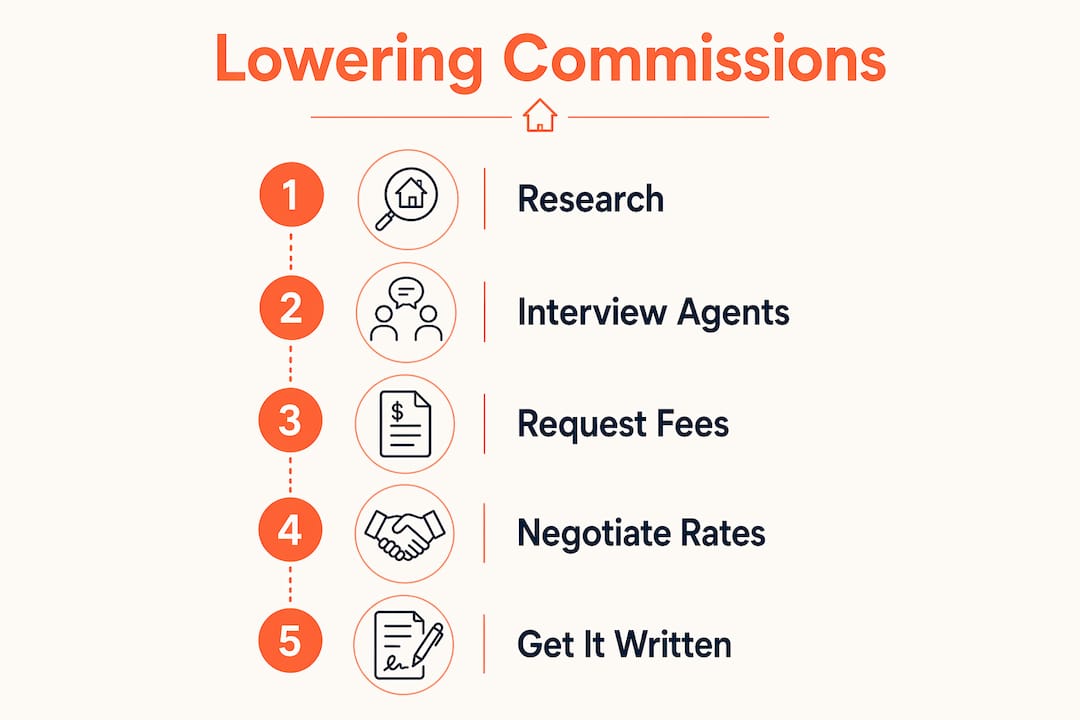
Preparation is what separates sellers who get a better rate from those who accept the first number an agent quotes. Follow these steps before you sit down with any agent.
- Research local commission rates. Average rates vary by city and market. Knowing the typical range in your area gives you a credible starting point for any conversation.
- Interview at least three agents. Interviewing multiple agents and comparing fee and service specifics often leads to lower commissions. A quoted 3% can reduce to 2.5% simply by asking.
- Request a written service checklist. Ask each agent to list every service they provide for their fee. This prevents surprises and makes it easy to compare agents side by side.
- Assess your leverage. A high-value home in a strong seller’s market gives you more negotiating power. An agent who wants a desirable listing has real incentive to compete on price.
- Understand the new buyer-agent rules. After august 17, 2024, MLS listings no longer include buyer-agent compensation offers. Buyer-agent fees are now negotiated separately in written agreements. This means you need to understand both sides of the commission equation before signing anything.
Pro Tip: Request a line-item fee schedule from every agent you interview. A written breakdown of costs and services lets you negotiate specific line items rather than just the total percentage.
You can also use the commission savings calculator at Realtorfinder to estimate how much different rate scenarios would save you on your specific sale price. Running those numbers before your agent interviews gives you concrete figures to reference in the conversation.
What negotiation strategies actually lower commissions?
Asking for a lower rate is the single most effective tactic, and most sellers never do it. Negotiating a lower commission rate politely and respectfully yields better results than aggressive tactics. Frame the conversation as a mutual benefit, not a confrontation.
Here are the strategies that work:
- Ask directly. Tell the agent you are interviewing multiple candidates and ask if their rate is flexible. A simple, direct question opens the door.
- Propose a tiered commission structure. Tiered commission structures with a base lower rate plus a bonus for selling above a target price align your incentives with the agent’s. You pay less if the home sells at the base price, and the agent earns more if they push higher.
- Offer to handle specific tasks yourself. If you can manage professional photography, staging, or open house coordination, offer to take those off the agent’s plate in exchange for a reduced fee.
- Bundle transactions. If you are buying and selling simultaneously, or if you have a family member also selling, offer the agent both transactions. Volume gives you real leverage.
- Highlight your home’s appeal. A well-maintained home in a desirable neighborhood is an easy listing for an agent. Point that out. Easy listings are worth a discount.
- Be ready to walk away. Negotiation success depends on local market conditions and the agent’s workload. If an agent will not budge and their service does not justify the rate, move on to the next candidate.
Pro Tip: Never negotiate verbally only. Once you agree on a rate and service scope, get every detail in the written listing agreement before you sign.
Understanding how agent reviews compare across candidates also helps you decide which agents are worth paying more for and which ones you should push harder on price.
What alternatives exist to traditional realtor commissions?
If direct negotiation does not get you to the savings you need, realtor commission alternatives can close the gap. Each option shifts more responsibility to you in exchange for lower costs.
For Sale By Owner (FSBO) eliminates the listing agent’s commission entirely. Using FSBO can lower or eliminate typical commissions but shifts all responsibilities to the seller, including marketing, showings, negotiations, and closing paperwork. FSBO works best for sellers with real estate experience or strong local market knowledge.
Low-commission and flat-fee brokers offer a middle path. Low-commission brokers usually provide full service by licensed agents, but in-person support is often limited geographically or by appointment. Before choosing one, verify that the agent operates in your specific area and confirm their availability for showings and negotiations.
iBuyers and cash buyers charge service fees instead of commissions, but those fees often match or exceed traditional commissions. The trade-off is speed and certainty, not savings.
The hidden cost in every alternative is time. Flat-fee or low-fee brokers shift seller responsibilities such as showings, buyer qualification, and paperwork management to the seller. That time has real value. Calculate it honestly before choosing a cheap realtor service over a full-service agent.
Key Takeaways
The most effective way to lower realtor commission fees is to interview multiple agents, request written fee schedules, and negotiate directly before signing any listing agreement.
| Point | Details |
|---|---|
| Fees are negotiable | No law sets commission rates; every percentage is open to discussion before you sign. |
| Preparation wins negotiations | Interviewing three or more agents and comparing written service lists gives you real leverage. |
| Tiered structures save money | A base rate plus a performance bonus aligns agent incentives and can reduce your total cost. |
| Alternatives carry trade-offs | FSBO and flat-fee brokers cut costs but shift significant work and time to the seller. |
| Post-2024 rules changed the game | Buyer-agent fees are now negotiated separately, making full commission transparency a seller’s right. |
What I’ve learned after years of watching sellers negotiate commissions
Most sellers walk into agent interviews without a number in mind. They hear a percentage, nod, and sign. That single moment of hesitation costs them thousands of dollars on a transaction where every dollar matters.
The sellers who get the best rates share one habit: they treat the agent interview like a job interview, not a sales call. They come with questions, they ask for written breakdowns, and they are genuinely willing to choose a different candidate. That posture alone changes the dynamic of the conversation.
Here is the part most articles skip: negotiating too hard on commission can backfire. An agent who feels squeezed may deprioritize your listing when a better-compensated one comes along. The goal is a fair rate for genuine service, not the lowest possible number. A motivated agent who earns a reasonable fee will outperform a reluctant agent who accepted a cut-rate deal.
My honest advice is to focus your negotiation on service clarity first and price second. Ask what you get, confirm it in writing, and then discuss the rate. That sequence produces better outcomes than leading with a number and hoping the agent fills in the service gaps later.
— Joe
How Realtorfinder helps you compare agents and commissions
Finding agents who compete on both price and service used to require weeks of cold calls and guesswork. Realtorfinder flips that model by letting you list your property once and receive competitive proposals from licensed agents.

Each proposal includes the agent’s commission rate, marketing plan, and track record, so you can compare like for like without pressure. The commission savings calculator shows you exactly how much each rate scenario saves on your sale price before you commit to anyone. You can browse seller resources to understand what full-service agents should deliver at every price point. When agents compete for your listing on Realtorfinder, the commission conversation starts from a position of transparency, not guesswork.
FAQ
What is the average realtor commission rate in 2026?
Realtor commissions are typically split between the listing agent and the buyer’s agent, with total fees historically ranging from 5% to 6%. Rates vary by market, home price, and agent, and all fees are negotiable before signing.
Can I negotiate realtor fees after signing a listing agreement?
Renegotiating after signing is difficult and depends on the contract terms. The best time to negotiate is before you sign, when you have the most leverage and the agent is still competing for your business.
What is the difference between a discount broker and a flat-fee MLS service?
A discount broker provides agent services at a reduced commission of 1%–2%, while a flat-fee MLS service charges a fixed amount of $300–$900 to list your home and leaves most tasks to you. Discount brokers offer more support; flat-fee services offer more savings.
How did the 2024 NAR settlement change commission negotiations?
The NAR settlement removed buyer-agent compensation offers from MLS listings starting august 17, 2024. Buyer-agent fees are now negotiated separately in written agreements, giving sellers more control and visibility over total commission costs.
Does a lower commission mean worse service?
Not automatically. Some agents accept lower rates on desirable listings or high-value homes because the transaction is straightforward. The key is to confirm in writing exactly which services are included at the agreed rate before you sign.
Recommended
Ready to sell smarter?
List your home free and let licensed realtors compete for your listing.
List Your Home Free